© Marthe Lallemand 2025
© Marthe Lallemand 2025
© Marthe Lallemand 2025
Kontext
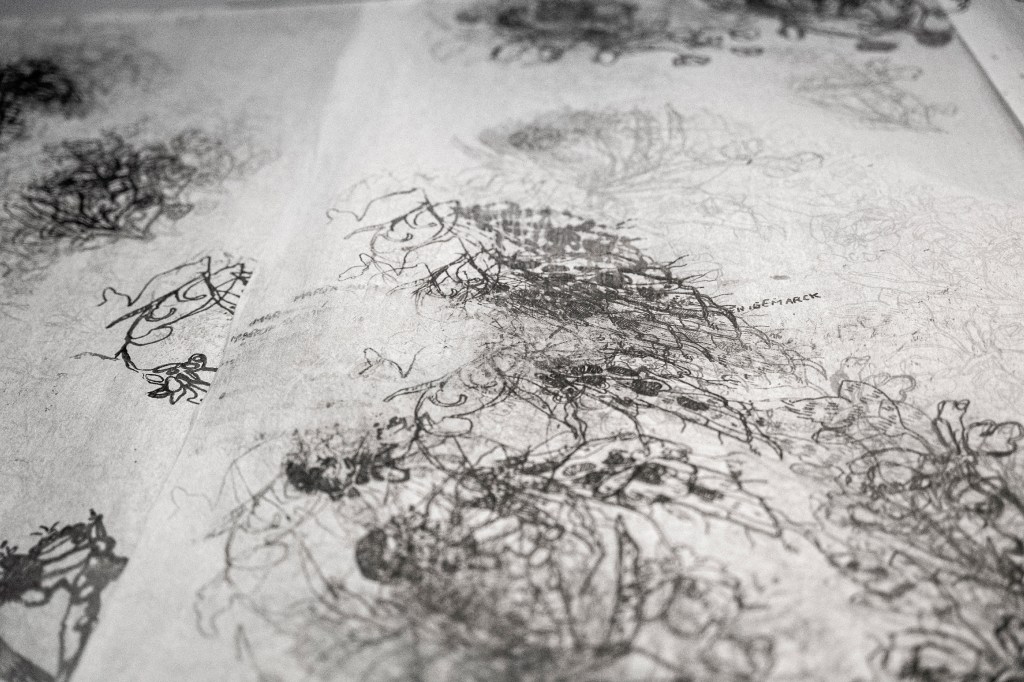
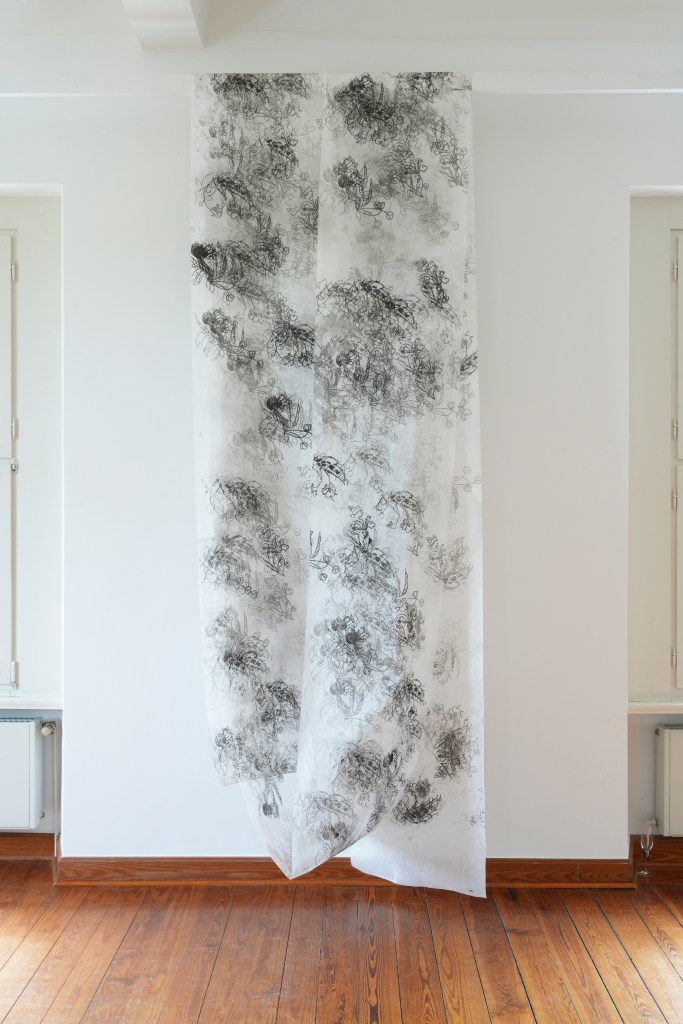
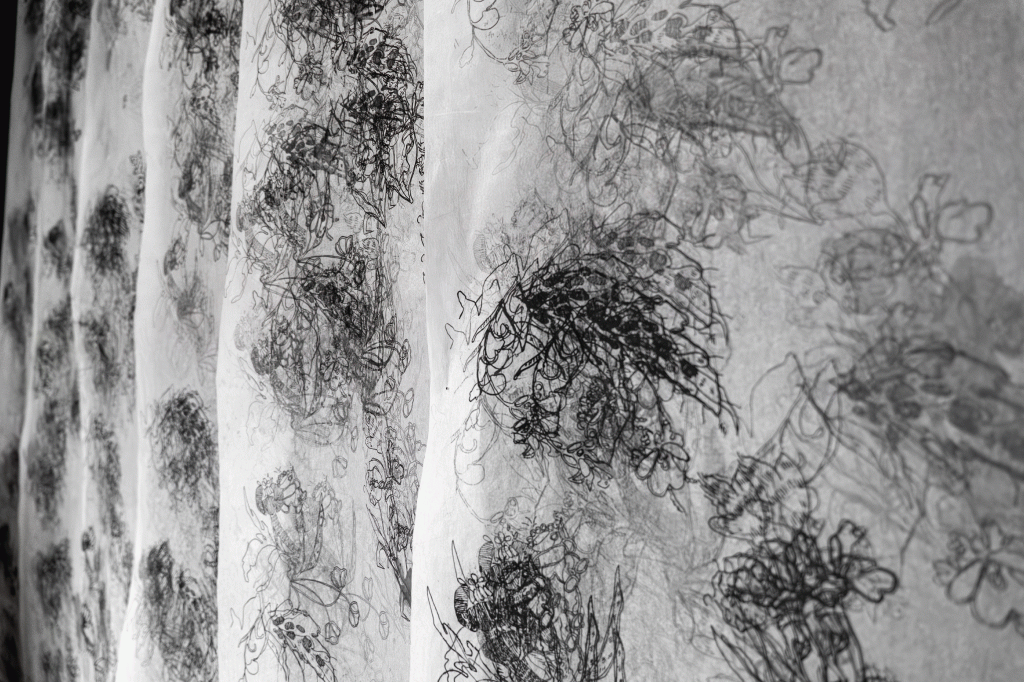
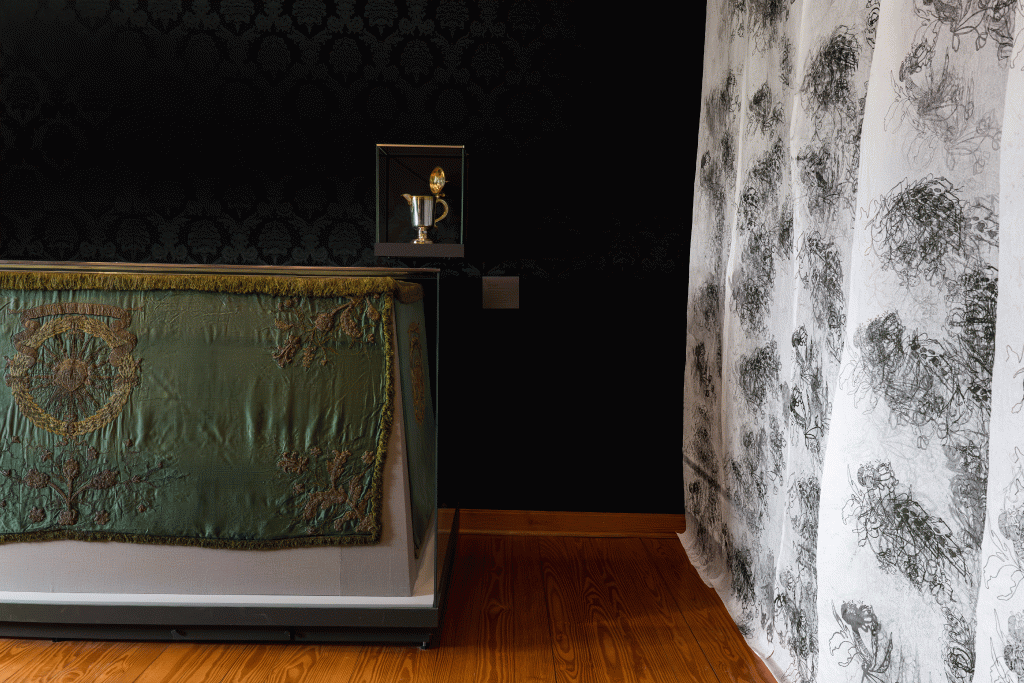
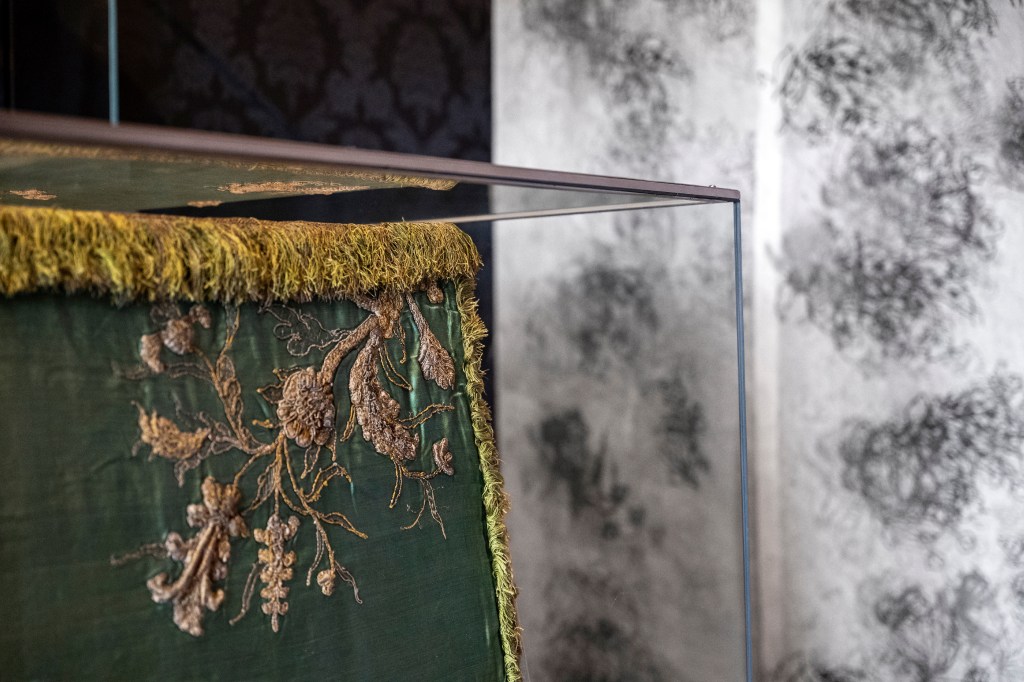
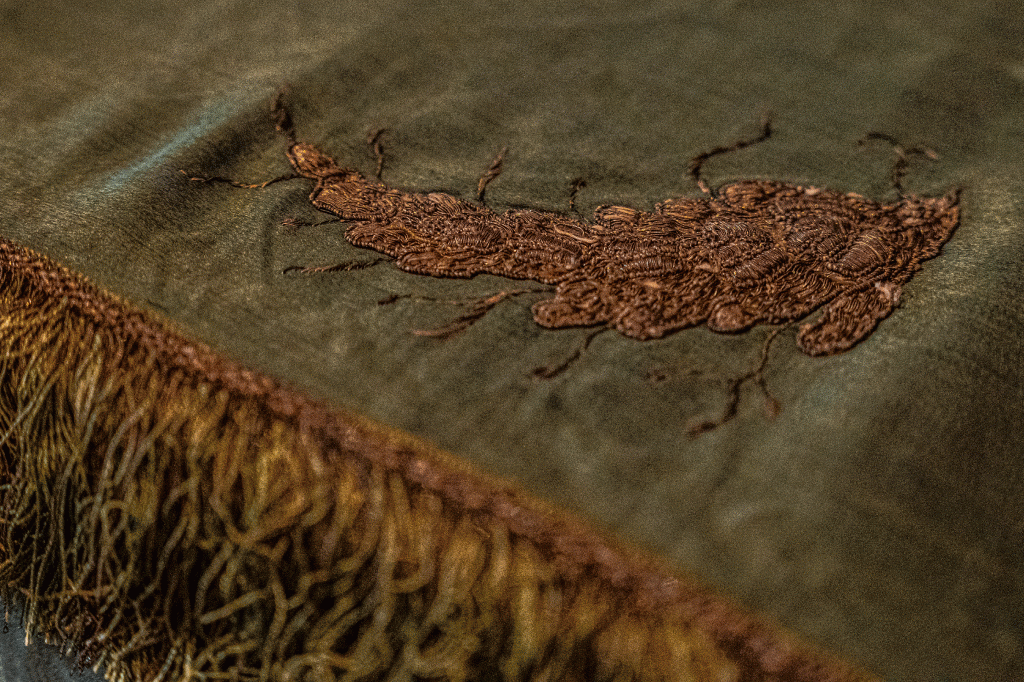
Ausgangspunkt meiner Arbeit war ein florales Motiv auf der Altardecke im sogenannten m Witwenraum des Schlosses Agathenburg. Die stickereibedeckte Altardecke wirkt wie ein textiles, bewegliches Objekt, das bedeckt und bekleidet. Die Stickerei wird zur Zeichnung, das Ornament zum Träger von Verknüpfungen. Einige Linien wurden mit Kupferdraht nachgezogen, andere im Siebdruck überlagert. Transparenz, Wiederholung und Verschiebung prägen diesen zweiten Schritt, in dem das Papier Feuchtigkeit aufnimmt, ohne zu reißen.
Im Rahmen der seit einem Jahr geplanten Zeichnungsausstellung im Schloss hatte ich von Anfang an die Intuition, ein Projekt zu entwickeln, das in direktem Bezug zu diesem Ort steht. Ich unternahm deshalb einen ersten Besuch, um zu beobachten, zu lernen, was hier geschehen war, und um den Raum zu erproben – eine Art Erkundung, wie sie Regisseur*innen vor einem Filmdreh durchführen, nur dass ich kein technisches Team habe. Dass ich meine Arbeit an den Ort anpasse oder sogar „tarne“, ist für mich auch eine Möglichkeit, so nah wie möglich an einem intimen, nicht-institutionellen Raum zu bleiben – jenem oft verborgenen Raum, aus dem Künstlerinnen historisch heraus gearbeitet haben. Es ist eine Form von aktiver, aus ihrem ursprünglichen Rahmen gelöster Intimität, die sich institutionellen Kategorien entzieht.
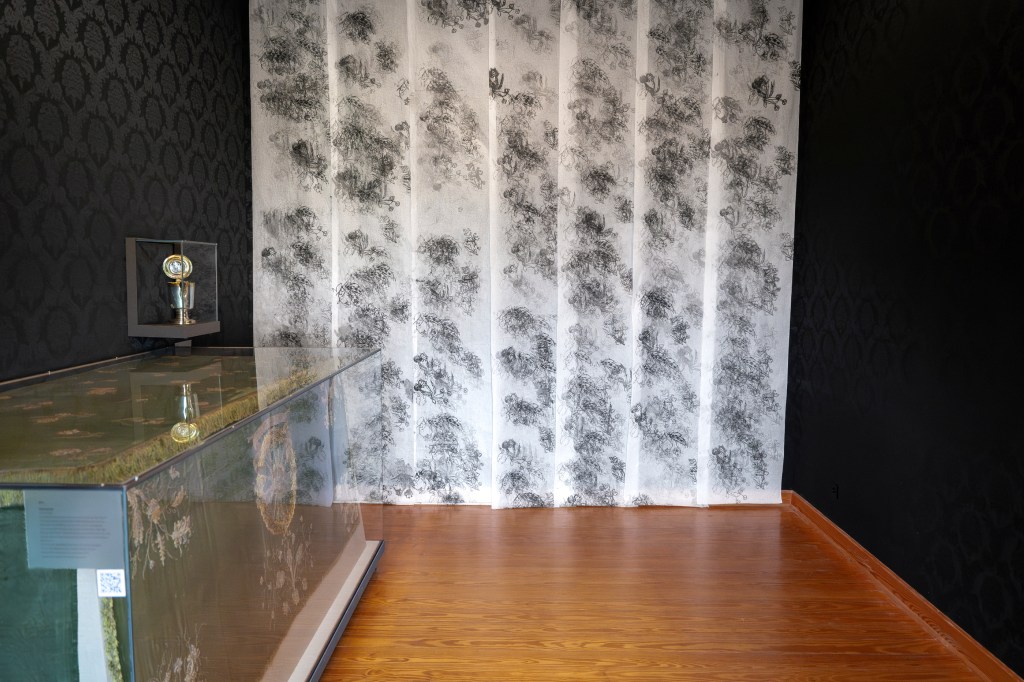
Bei diesem ersten Besuch hat mich besonders der Witwensaal beeindruckt: Die Wände sind mit schwarzer, geprägter und samtiger Tapete verkleidet, und in einer großen Vitrine befindet sich ein smaragdgrünes Altarstück. Das Objekt, mit kostbaren Stickereien aus dem 17. Jahrhundert verziert, nimmt fast den gesamten Raum ein. Nicht seine liturgische Funktion war es, die mich anzog, sondern seine starke Überlagerungskraft – diese Fähigkeit, ebenso zu verbergen wie zu enthüllen. Textil, Motiv und Schicht wurden zu den treibenden Elementen meines Blicks. In diesem Moment wurde mir auch klar, dass die grafische Basis meiner Arbeit – die ich in Siebdruck weiterentwickeln wollte – bewusst auf Schwarz, Weiß und Grauabstufungen reduziert bleiben musste.
Context
The starting point of my work was a floral motif on the altar cloth in the so-called Widow’s Room of the castle Agathenburg. The embroidery-covered altar cloth appears like a textile, movable object that both covers and dresses. The embroidery becomes a drawing, the ornament a carrier of connections. Some lines were retraced with copper wire, others overlaid in silkscreen printing. Transparency, repetition, and displacement characterize this second stage, in which the paper absorbs moisture without tearing.
Within the framework of the drawing exhibition that had been planned for a year at the castle, I intuitively wanted to develop a project directly connected to this site. I therefore made an initial visit to observe, to learn what had happened there, and to experience the space – a kind of scouting, as filmmakers do before a shoot, except that I have no technical team. Adjusting or even camouflaging my work within the site is for me also a way to remain as close as possible to an intimate, non-institutional space – that often hidden space from which women artists have historically worked. It is a form of active intimacy, detached from its original framework, that escapes institutional categories.
During this first visit, I was particularly struck by the Widow’s Room: the walls are covered with black, embossed, velvety wallpaper, and in a large display case there is an emerald-green altar piece. The object, adorned with precious seventeenth-century embroidery, occupies almost the entire room. It was not its liturgical function that attracted me, but its strong power of superimposition – this capacity to conceal and reveal at the same time. Textile, motif, and layer became the driving elements of my gaze. At that moment, it also became clear to me that the graphic basis of my work – which I planned to develop further in screen printing – had to remain deliberately reduced to black, white, and shades of grey.
© Marthe Lallemand 2025
Geschichte
Wie eine Archäologin begann ich, die Schichten dieses Raums und dieses verhüllenden Objekts zu analysieren, bis ich eine visuelle Präsenzform isolieren konnte, die ich plastisch aktivieren konnte. Die Altardecke ermöglichte mir, eine Reflexion über das Bild als Handarbeit fortzuführen – eine Arbeit, die historisch Frauen zugewiesen war: Illuminatorinnen, Stickerinnen, Werkstattleiterinnen, wie es Pollock und Parker dokumentiert haben. Nicht die religiöse Funktion des Objekts stand für mich im Vordergrund, sondern seine fragmentarische Komposition und seine Logik eines autonomen Ornaments. Wie Christine Aribaud gezeigt hat, verlagerte die religiöse Stickerei des 17. Jahrhunderts das Bild an die Ränder des Textils und des Kirchenschiffs, entsprechend einer Ökonomie des Hintergrunds. Das Bild drängt sich nicht mehr frontal auf, es verteilt sich. Dieses visuelle Regime erlaubte mir, das Bild nicht mehr als Tafelbild, sondern als Anordnung von Flächen, Unterbrechungen und visuellen Schwellen zu denken.
History and Layers
Like an archaeologist, I began to analyze the layers of this room and this concealing object until I could isolate a form of visual presence that I could activate plastically. The altar cloth allowed me to continue a reflection on the image as handwork – a kind of work historically assigned to women: illuminators, embroiderers, workshop heads, as documented by Pollock and Parker. What mattered to me was not the religious function of the object, but its fragmentary composition and its logic of autonomous ornament. As Christine Aribaud has shown, 17th-century liturgical embroidery displaced the image to the edges of the textile and of the nave, according to an economy of the background. The image no longer imposes itself frontally; it distributes itself. This visual regime enabled me to think of the image no longer as a frontal panel but as an arrangement of planes, interruptions, and visual thresholds.